
Family Dinner
Culinary traditions bind generations

If I were to tell you that my partner and I once drove 400 miles for a single meal last year (and are repeating the pilgrimage as you read this) you might assume that our destination had been some fancy Michelin-starred restaurant in a big city, or perhaps a trendy and sophisticated culinary oasis in the woods.
Nope.
It’s true that Leslie and I routinely travel hundreds or even thousands of miles to experience specific scenic, cultural or historical wonders. In this case, however, the destination and the journey were of secondary importance. Food was on the agenda during that trip last February, but although the meal itself was memorable, it was equally a celebration of our shared culinary heritage — food traditions that maintain the mystical bonds of family and memory that connect me to my parents, siblings, children, grandchildren and grandparents.
I should also mention that it was delicious.
Our destination was the small town of Sonoma, in the heart of Northern California wine country, and the home of my brother Jason and his wife, Liz. For many years, and in various dwellings, they have hosted an annual gathering and meal featuring a dish passed down to us from my dad’s mom — Nonna, to me and my siblings — that over time has taken on the aura of sacred ritual.
Nonna was born Teresa Cernusco, the daughter of immigrants from the Italian region of Piedmont, which is home to both sophisticated Barolo wines and simple peasant cuisine, the culinary art of making the most of very little. She was in many ways a force of nature: mercurial, tough, resourceful, manipulative, fiercely protective of family. Among the great gifts she bestowed on us was the traditional Italian dish known as bagna cauda.
All or nothing
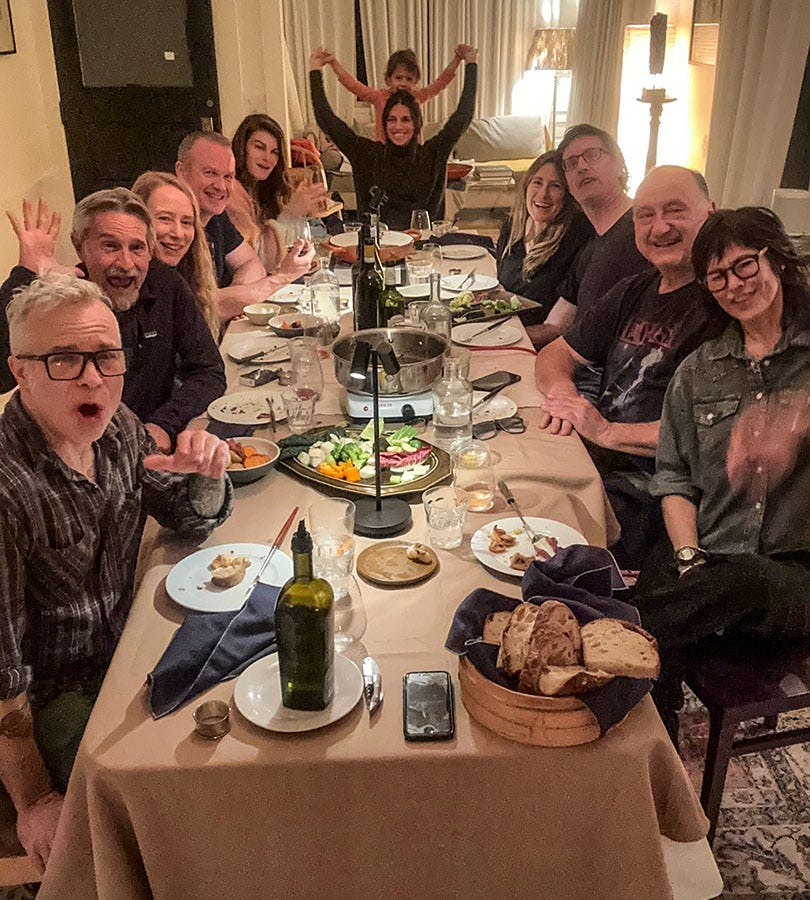
“Piedmont” literally means “foot of the mountains” in Italian; the region lies at the base of the Alps and is bordered by France and Switzerland. “Bagna cauda” means “hot bath” and refers in this instance to a sauce consisting of garlic, anchovies, butter and olive oil, simmered together for hours until they form a thick mélange into which diners dip crusty bread and a variety of raw vegetables while it remains on heat at the table. Think fondue with bubbling garlic-anchovy paste standing in for molten cheese.
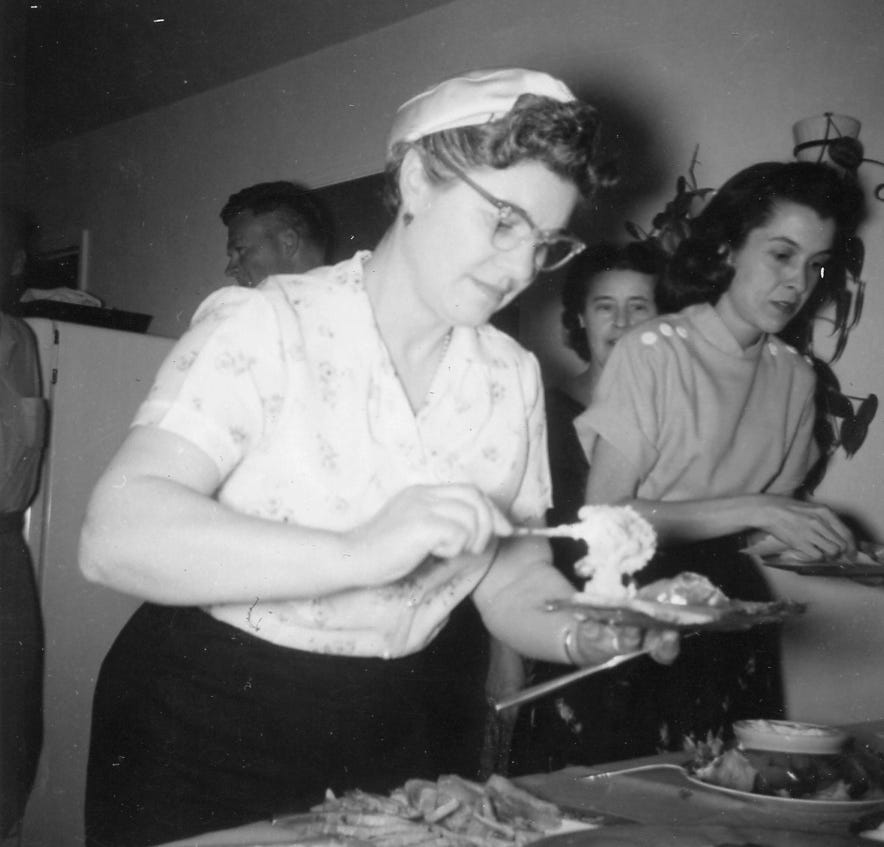
It is not for the gustatory faint of heart. I grew up with the pungent dish, so no longer recall my initial reaction. But my mom, introduced to it as a young wife trying hard to embrace her new husband’s culinary heritage, wrote about it many years later, so I will quote her here.
Just as Christmas meant raviolis, so New Year’s meant bagna cauda. When John [my dad] was a boy in Colorado, the cold weather meant that the coal stove was always hot. The stove lids would be used under the bagna cauda to keep it hot; when one cooled, another hot lid was put in its place. That could be one reason why the dish was served in the winter, but more likely, it was that the garlic acted as a good spring tonic to purge the system.
When I met Teresa, the coal stove was long gone, and the bagna cauda was prepared in an electric frypan. It’s a very simple dish, involving huge amounts of sliced garlic, a cube of butter, anchovies and olive oil. All sorts of raw vegetables are cut into bite-size pieces and arrayed in bowls surrounding the frypan. Sliced French bread is added to the table, and then everyone gathers around to spear vegetables, swirl them in the hot bagna cauda, and, using a piece of bread to catch the drips, and being careful not to burn one’s mouth, the feast begins.
Of course, after a bagna cauda feast, one is not good company for a couple of days. The garlic seems to ooze from one’s pores. One year, we joined Teresa for bagna cauda, and then we all went off to New Year’s Mass. As we quietly settled into our pew, several adjoining pews began to empty out. We had forgotten about the garlic factor!
There has only been one year when I couldn’t partake of the bagna cauda feast, and I was very upset about it. But I was nursing my firstborn [that would be me] and somehow didn’t think it would be a good idea to feed him garlic-laced milk.
As our children grew up and began to bring home prospective future spouses, we jokingly said that if they could eat bagna cauda and enjoy it, then they were eligible to join the family. I choose to believe that they weren’t faking the enjoyment; bagna cauda isn’t the kind of dish that one can like a little bit. It’s all or nothing.
Our son Jason and his wife Liz have taken on the bagna cauda meal and have added many new vegetables to the table. One year, Jason decided to add a bit of lemon juice to the bagna cauda and heard about it big time. One doesn’t mess with certain traditions. Add all the different vegies you want, but don’t try to improve on perfection!


The unexpected treasure
I did not know my mom as a writer until the final year of her life.
In February 2022, she fell at my parents’ home in Sebastopol and broke her femur, precipitating a long and increasingly serious cascade of health problems that ultimately resulted in her death 10 months later. That spring, during one of numerous trips north that Leslie and I made that year, my dad told me he had some files on his computer he thought I would like to see. He copied them to a thumb drive, and when I returned home, I began opening them, not knowing what to expect.
They turned out be hundreds of pages of Mom’s writing: recipes, reminiscences, classroom materials from her years as a teacher, essays that likely were assignments for college writing classes, travel diaries, children’s stories, and letters — so many letters, addressed to family and friends, to senators and county supervisors, to unhelpful customer service departments and to the editor of the local newspaper.
It’s difficult to know with any precision when most of these documents were written; many lack dates, and the file creation data are not reliable because some have been converted from one software format to another over time. Nevertheless, judging by their content, they appear to have been written in a period of little more than a decade, from the mid-1990s until around 2009, long after I had left home and established my own life and family far away. Until my dad’s revelation, I was utterly unaware of their existence.
And what a remarkable treasure they are.
What emerged from those documents was a Mom I don’t think I or my siblings really knew or appreciated when we were growing up. She was a fluid writer with an authentic voice, and she was a keen observer as well — both of the natural world in all its mystery and beauty, and of the internal human world, in all its complexity, contradictions, joys and sorrows.
I spent the next several months gathering, editing and formatting a representative collection as a book to share with family, illustrated with vintage photos from the family archive, so we could at last appreciate this aspect of her. As a writer for my entire adult life, I recognized during that project my creative kinship with Mom, and the common wellspring of our impulses to document our lives. I believe that is why my dad ensured I would see her words.
The book I built out of my mother’s scaffolding came back from the printer about a week before Mom and Dad died, six days apart, that December. Neither of them had a chance to see it.
All about the crab
My self-assigned role in the familial food tradition arena is to host a pre-Christmas cioppino feed each December. I cannot remember when I began doing so, but it has been at least two decades, maybe longer, and Leslie has enthusiastically signed on as co-host.
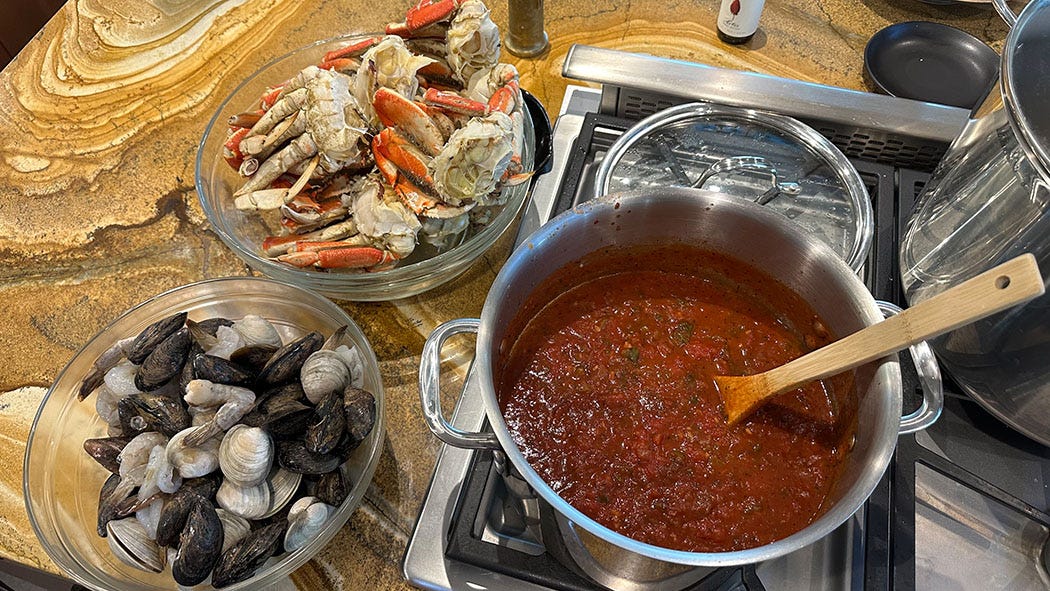
Cioppino is a version of the traditional seafood stew common to many Mediterranean cultures, but built on a base of robust tomato-garlic-wine sauce. Although the list of ingredients varies regionally and seasonally, my iteration is based on the one developed by Italian-Americans in San Francisco’s North Beach neighborhood, where I was born and spent the first five years of my life. It includes shrimp, black mussels and clams, but the featured superstar is Dungeness crab, for my money the most delectable crustacean in the ocean and one found only along the Pacific coast from Point Conception north to Alaska. California’s commercial Dungeness season historically has opened in November or December, making the crabs a popular centerpiece of celebratory Northern California meals in the Christmas season.
In recent years, Cioppino Weekend has expanded to absorb another family culinary tradition: home-made raviolis. Like bagna cauda, this is one we inherited from Nonna, and again I will turn to my mom to describe its origins.
When I met John and began spending time with his family, I came bringing my own holiday food traditions. Christmas always meant cookies, especially my Mom’s delicious sugar cookies, and we always had home-made candy. Mom liked to bake, and that’s where she put most of her efforts.
Then I met Teresa, and Christmas was never again the same. My family celebrated with goodies and presents and a tinsel-covered tree. Mom got out all the old sheet music, and almost every night we joined her at the piano for good old sing-alongs. Teresa CELEBRATED Christmas. Her preparations began many weeks before with a top-to-bottom house cleaning, craft projects that would produce such things as a church made from macaroni, and, then, as the days grew shorter and Christmas drew near, she began the baking of nut bread and panettone. The high point of the preparations was the making of the raviolis.
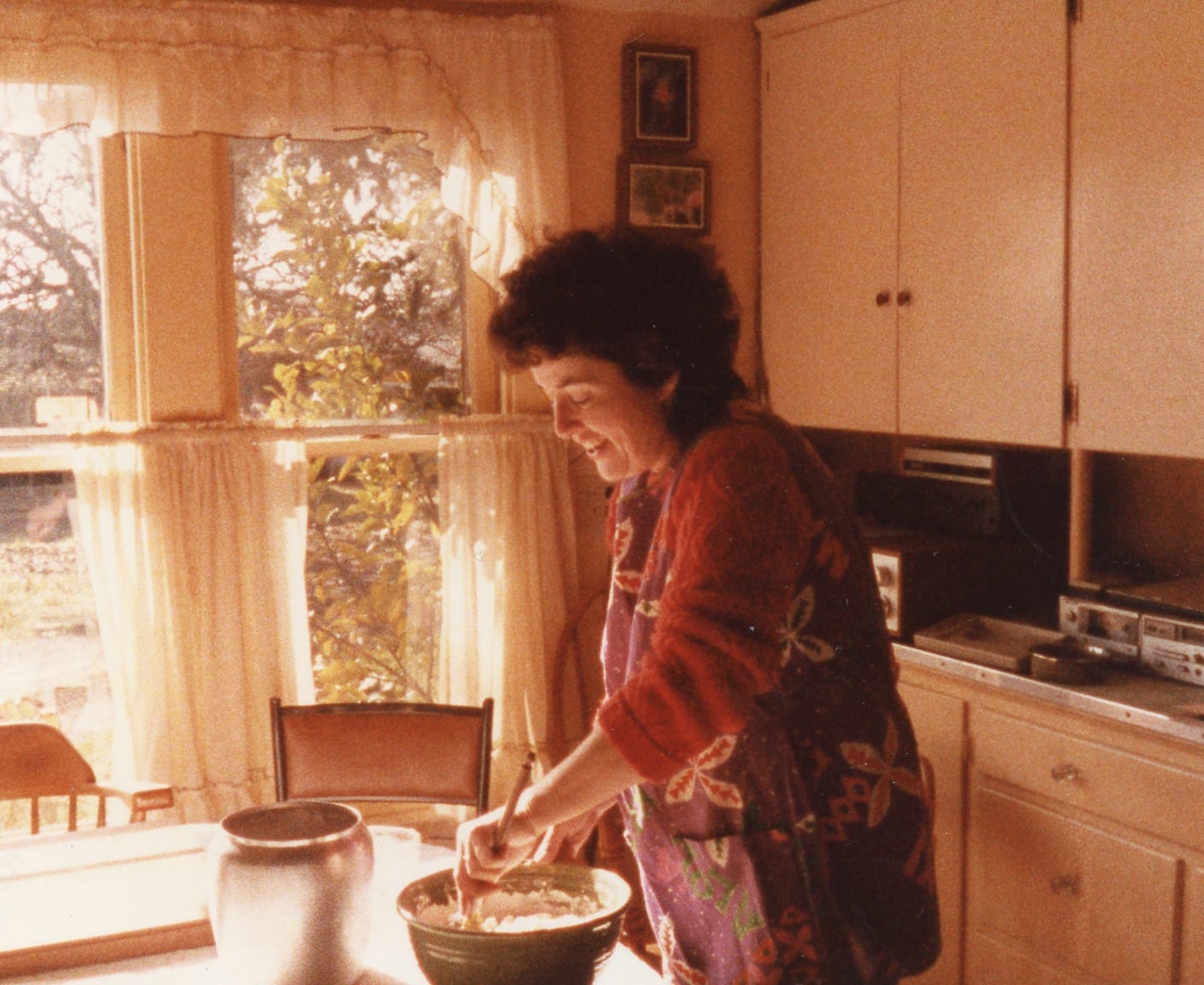
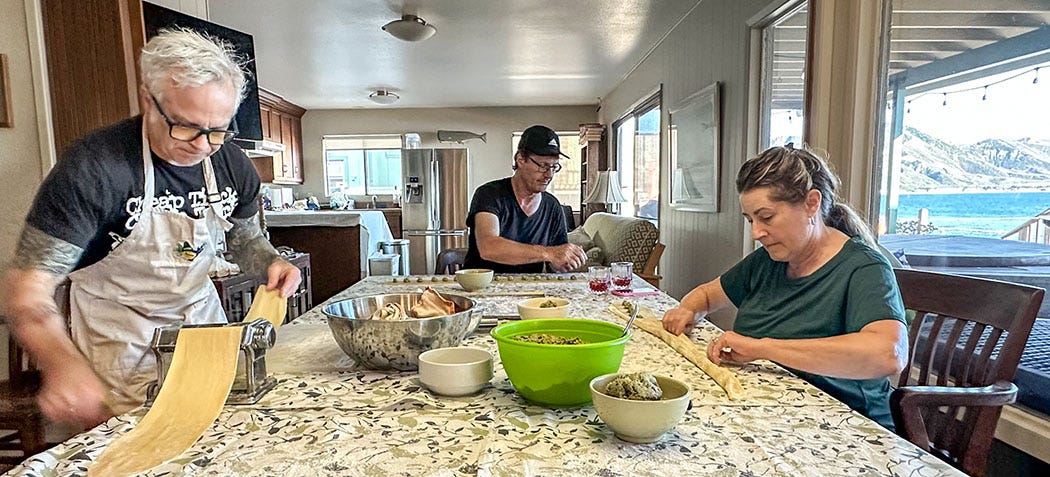
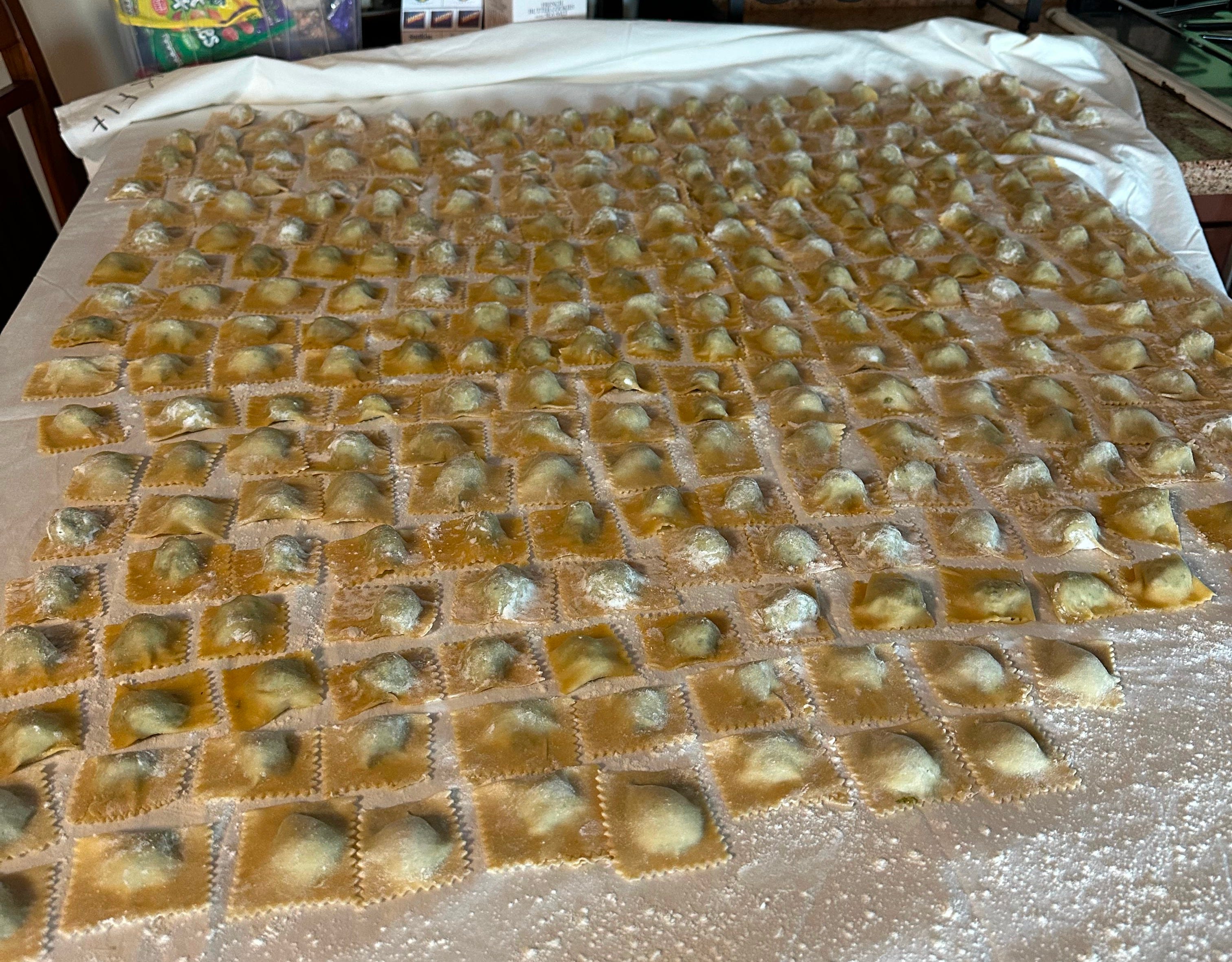
Ravioli making was spread out over several days. On the first day, a pork roast was prepared, and a chicken was boiled. On the second day, the ravioli filling was made. And on the third day, the call went out, and any available family members joined Teresa in making the raviolis. The antiquated pasta machine was produced, adjusted and fastened to the sheet-covered dining room table. Flour was shaken on the sheet to keep the pasta from sticking, and then the pasta making began. Long strips would be laid out in front of each helper, and then tiny spoonsful of filling would be dotted along the strips. The pasta would be folded over the filling, and then the helpers would use their fingers to isolate each little lump of filling from the next, being careful to crimp tightly so that no air got in. The final step was to use a pizza cutter to trim the edges and separate each ravioli from its neighbor. Someone was always in charge of carrying off the finished raviolis to a sheet-covered card table so that they could dry. Ravioli making was a long, tiring process, and always, in the background, Teresa would be saying “Don’t make them too big,” and “Don’t get air in them.” She was an exacting taskmaster.
As the years went by, I often thought about learning how to make the ravioli filling, but I never got around to it. Until the year that Teresa got sick. She’d had the flu around the beginning of December and just didn’t seem to recover. She had to admit that she needed help to prepare for Christmas. That was how I found myself joining her as she began to make the ravioli filling. I helped her each step of the way as she ground up the pork roast and chicken and the steamed Swiss chard and parsley and onion and garlic. I watched carefully as she shook in the seasonings (no measuring spoons, of course) and added a few eggs to keep the filling from being crumbly. That Christmas was special in many ways. It was to be our last Christmas at Nonna’s. By the following March, she was dead from pancreatic cancer, and the heart seemed to go out of our family.
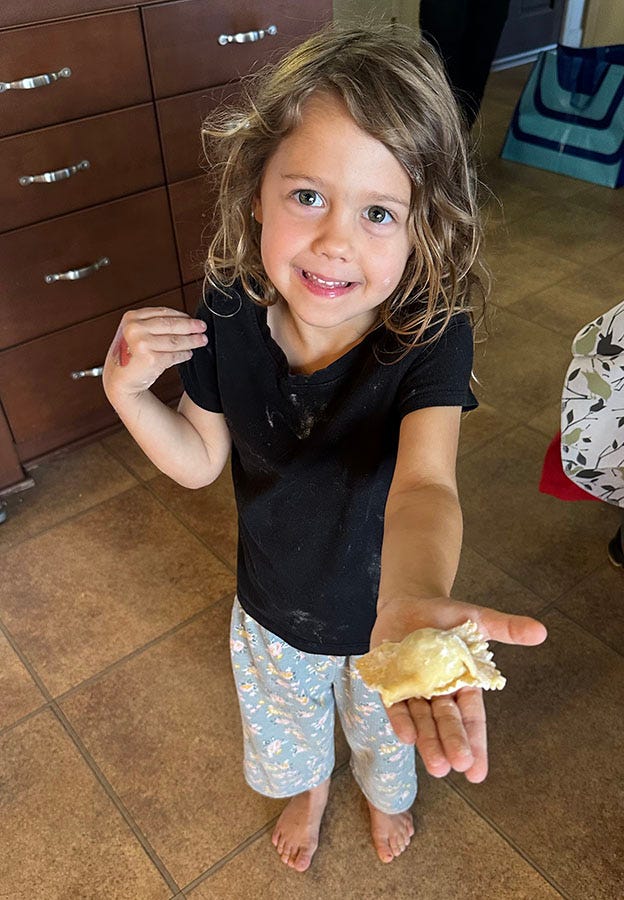
But each Christmas, I roast the pork and boil the chicken and prepare the filling, and then I put the word out that we need help. The next day, whoever is available joins us in the making of the raviolis, and as our children and now our grandchildren gather around the table, I can hear Teresa’s voice echoing down the years, “Don’t make them too big,” and “Don’t get air in them.” As we sit down to our Christmas raviolis, everyone swears that they taste just like Nonna’s, but I know there’s a difference. She was the master.
Next generation(s)
Technical note: Although we have referred to these all our lives as ravioli, they are actually agnolotti. Ravioli are made by pressing globes of filling between two sheets of pasta; the delectable little pillows we have been creating for generations are made with a single folded sheet, a classically Piedmontese variant.
Whatever. Nonna called them ravioli and who are we to second-guess the master? My brother Jason and sister Stephanie have taken the lead on preparing the filling and sauce, and bringing them south to Ventura County for the ceremonial group assembly line and meal.
It’s clear that my mom had envisioned her documentation of the traditional family recipes we inherited from my grandmother as eventually being compiled in a book. She says as much in her intro to that section of her writing collection.
One day, as I was going through my recipes, I began thinking about my mother-in-law Teresa and how much she taught me about cooking. That got me to thinking about some specific recipes, such as bagna cauda; and that, in turn, got me to thinking about my grandchildren and wondering whether many of Teresa’s specialties would be lost and forgotten after my children’s generation is gone.
My children were fortunate to grow up with their “Nonna” nearby, and they also grew up loving her cooking. They were never surprised when in the spring Nonna would be found out in our yard with a knife and a bag busily harvesting tender dandelions and mustard, and picking watercress from our creek for her salads. In the summer, the children learned from her to go out to the garden early in the morning to pick the still-open squash blossoms to be breaded and fried. Christmas meant pannetone, nut bread and raviolis, and New Year’s meant bagna cauda.
Teresa is gone, but her recipes live on in my cooking and in the cooking of her four grandchildren. As far as I know, my grandchildren, Nonna’s great-grandchildren, have never seen their parents harvesting early dandelions and mustard, or picking squash blossoms from the garden. And most of Nonna’s recipes are time consuming to prepare. Will my grandchildren want to take the time to make raviolis by hand or peel and slice the many heads of garlic for bagna cauda? That’s why I am putting together this book. Even if Nonna’s recipes no longer come to life in the kitchen, they will always live in these pages.
My kids never saw me harvesting dandelion greens, mustard and squash blossoms from the yard. But I like to imagine that my effort to gather my mother’s writings into a book brought to fruition the posterity project she had envisioned. And as I make the journey north this year to share another bagna cauda weekend with my family — and having watched my children and now my grandchildren help make ravioli over the years — I can answer her question.
Yes, Mom, they will take the time. And at least some of those recipes will continue to live in the kitchens of future generations. You made sure of it.
That’s a wonderful early morning read. I’m especially impressed by how closely knit you are with your siblings.
Thanks John, what a beautiful and touching tradition you all have kept alive. Wonderful writing, thanks for starting off my Saturday with such a beautiful story. I would certainly travel 400 miles for that!